

Use Random Human-Readable Message Keys
Most i18n setups ask developers to name their message keys: login-button-label, user.profile.title. This seems sensible but causes problems. A better approach:
- "login-button-label"
+ "penguin_purple_shoe"
The Problem with Semantic Keys
Most i18n libraries encourage semantic keys like login.button.submit.
The key encodes where the message “belongs” in the UI or codebase. In practice, semantic keys create two recurring problems.
1) Keys are unstable
Semantic keys invite renaming.
-login-button-label
+continue-button-label
- A “login” button becomes a “continue” button
- A component gets moved
- A designer changes copy
References break
Code pointing to login-button-label now points to nothing. Depending on your setup, this fails at runtime, falls back to a placeholder, or silently ships missing strings.
Furthermore, and more importantanly, the linkage between translations is broken.
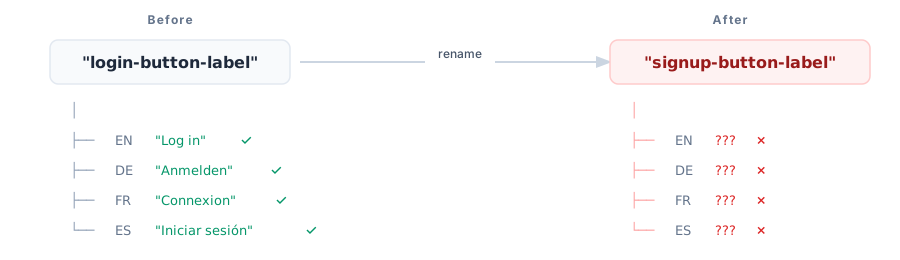
History disappears
Translation history, comments, screenshots, QA notes, and reviewer context are usually tied to the key. Rename the key and you start over.
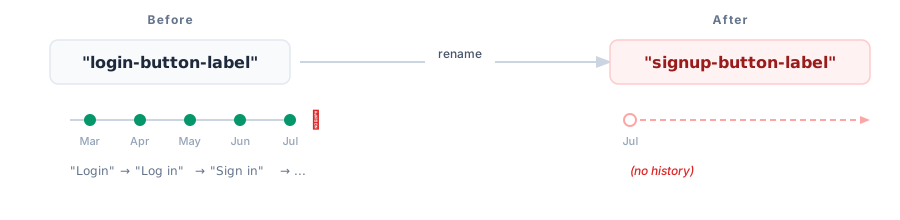
![NOTE] Tooling can mitigate this somewhat by tracking renames or fuzzy matching, but it’s complex and error-prone. The fundamental issue remains: keys are unstable.
2) Naming conventions are overhead
Semantic keys also create ongoing process cost:
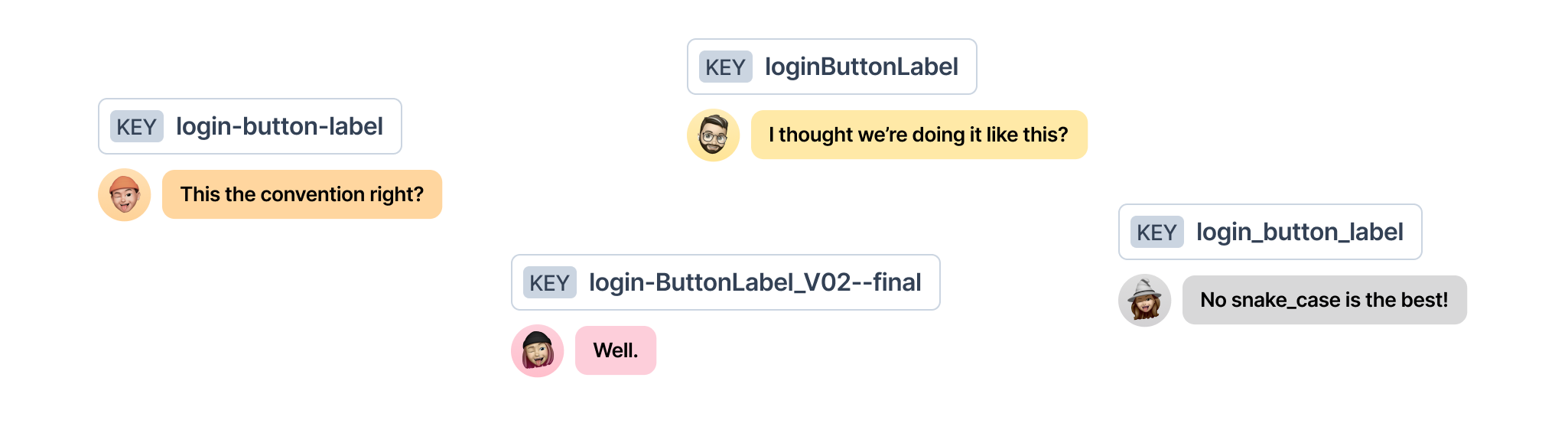
- Teams bike-shed naming style (
snake_casevskebab-casevscamelCase) - People argue about taxonomy (“is this
loginorauth?”) - Developers spend time designing keys instead of shipping features
Your product rarely benefits from the shape of the key - but your team pays for it repeatedly.
The Solution: Human-Readable Random Keys
Instead of semantic keys, auto-generate IDs that are:
- Stable: never changes once created
- Meaningless: no naming debates, no “correctness” arguments
- Human-readable: easy to communicate and search (
penguin_purple_shoe)
"penguin_purple_shoe"
A common approach is “three-word IDs” based on a word list (similar to what3words’ core idea of three-word identifiers, but for messages rather than locations).
See: https://what3words.com/about
The Tradeoff
You can't tell what a message contains from its key. penguin_purple_shoe says nothing about the text.
Without tooling, you'll grep through translation files. During code review, you'll see m.penguin_purple_shoe() and wonder what it says. That's friction.
Tooling removes this friction. An IDE extension like Sherlock shows the message content inline:
// IDE shows: "Log in to your account"
m.penguin_purple_shoe();
How Other Libraries Handle This
Popular i18n libraries have arrived at the same conclusion: auto-generated keys are better than manual ones.
FormatJS, the library behind react-intl, explicitly discourages manual IDs:
"Since manual IDs are discouraged, we've provided a babel plugin and a TypeScript AST transformer that will automatically insert message IDs in your transpiled code."
FormatJS generates hash-based IDs during extraction using patterns like [sha512:contenthash:base64:6], producing short identifiers like hak27d. Their reasoning: manually assigned IDs create collision issues and maintenance burden.
See also GitHub Issue #1892 for our original design discussion on this topic.
Why This Happens
The root cause: translations live in JSON files.
{
  "login-button-label": "Log in"
}
In JSON, the key is both the identifier and the human-readable name. There's no separation. Rename the key, lose the reference. This is the fundamental problem.
In any database, you'd have an id column (stable) and maybe an alias column (human-readable). The translation content lives separately. But JSON files collapse everything into one field.
Inlang gives you both: an open file format like JSON, but with database semantics because it's SQLite under the hood:
Bundle (id: "purple_horse_lamp")
├── Message (locale: "en", text: "Log in")
├── Message (locale: "de", text: "Anmelden")
└── Message (locale: "fr", text: "Connexion")
The id is stable. Plugins handle import/export to JSON, XLIFF, or whatever format you need. But the source of truth is the database, not scattered JSON files.
Learn more about inlang's architecture →
Summary
| Semantic Keys | Random Human-Readable Keys |
|---|---|
| References break on rename | Stable references |
| History lost on rename | History preserved |
| Naming conventions required | No conventions to enforce |
| Devs must create keys | Anyone can create messages |
Related:
- GitHub Issue #1892 - Original design discussion